TLDR:
Detectors flagged every one of our ten raw AI test documents. After v4, nine of ten read as human on GPTZero, and nine of ten on ZeroGPT.
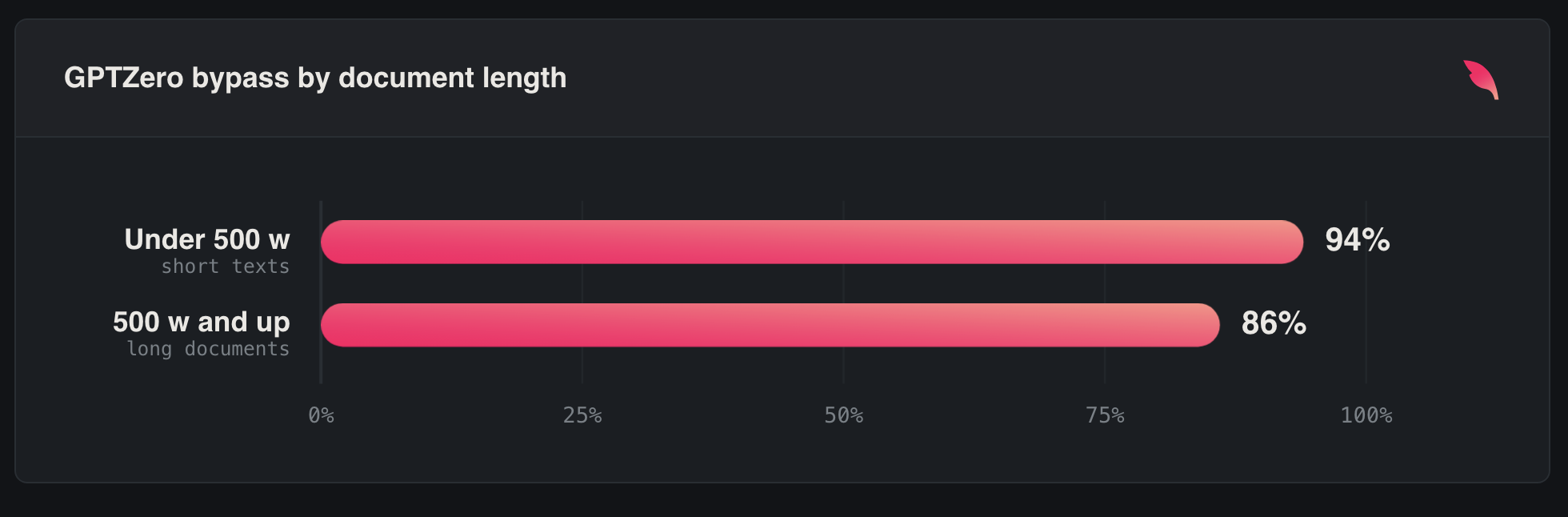
Short texts, the hardest case, clear at 94%.
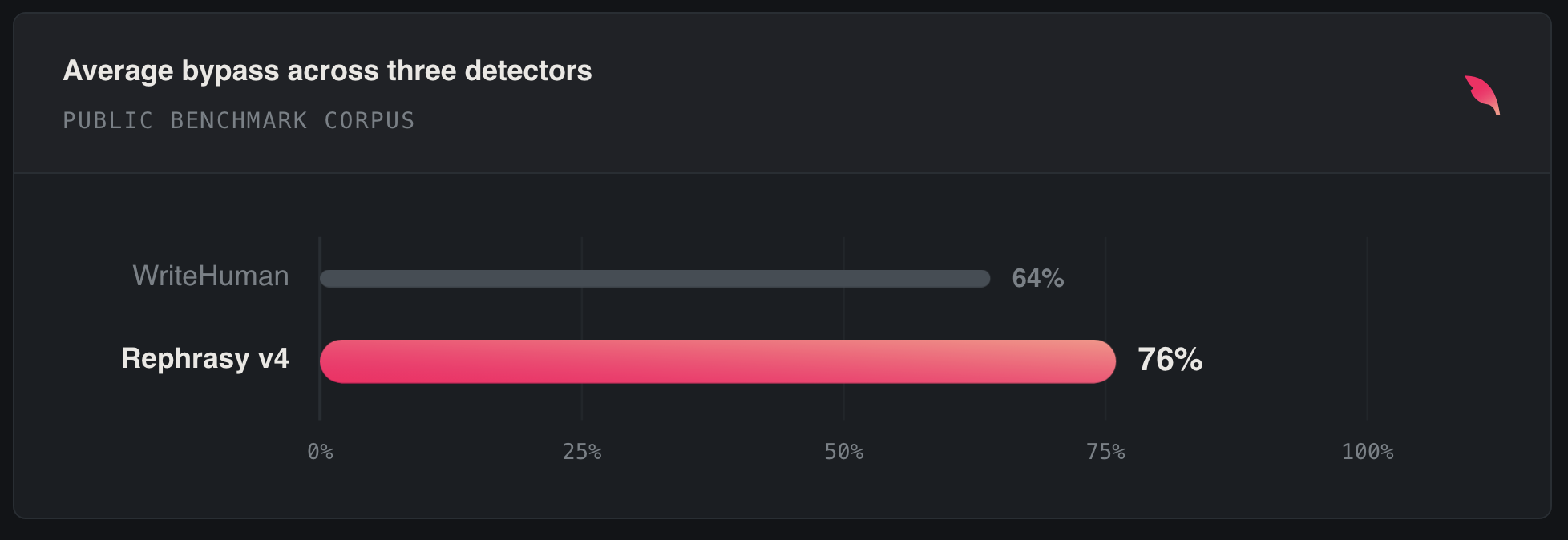
It beats WriteHuman on a public benchmark: 76% vs 64% averaged across three detectors.
Meaning similarity 0.925, length back at 1.05×, a 1,000-word document in ~ 10 seconds.
Disclaimer: Our internal testing on a dataset with X.XXX samples confirmed this. The small sample is just for simplicity and the blogpost.
Why we ran this experiment
Every humanizer trades two things against each other. Push harder on detector bypass and the text drifts away from what you wrote. Stay faithful to the source and the detectors light up. Most tools in this category move one number and quietly give up the other, and the number they publish is always the flattering one.
There is a second problem with how this gets measured. A fixed benchmark stops being a test once you have tuned against it. We have watched models look excellent on a corpus they were built against and ordinary on anything new.
So before we changed the model, we changed the test.
The setup
Ten documents, generated fresh for this comparison and seen by nothing beforehand. 250 to 1,000 words, spread across blog posts, personal essays, explainers, product reviews, academic writing and reports. Each one goes through v4 on the same path a customer request takes, and every output gets scored two ways:
Bypass — three independent detectors, reported as 1 minus the detector's AI probability.
What survived — meaning similarity to the source, length, whether figures and names came through unchanged.
A release only ships if both halves hold. Then we ran the documents past the detectors untouched, to establish what we were starting from.
Three detectors, not just one
Detectors disagree with each other, and optimising for a single one is how you end up with a model that passes GPTZero and fails everywhere else. We watch three, and a release has to hold up on all of them.
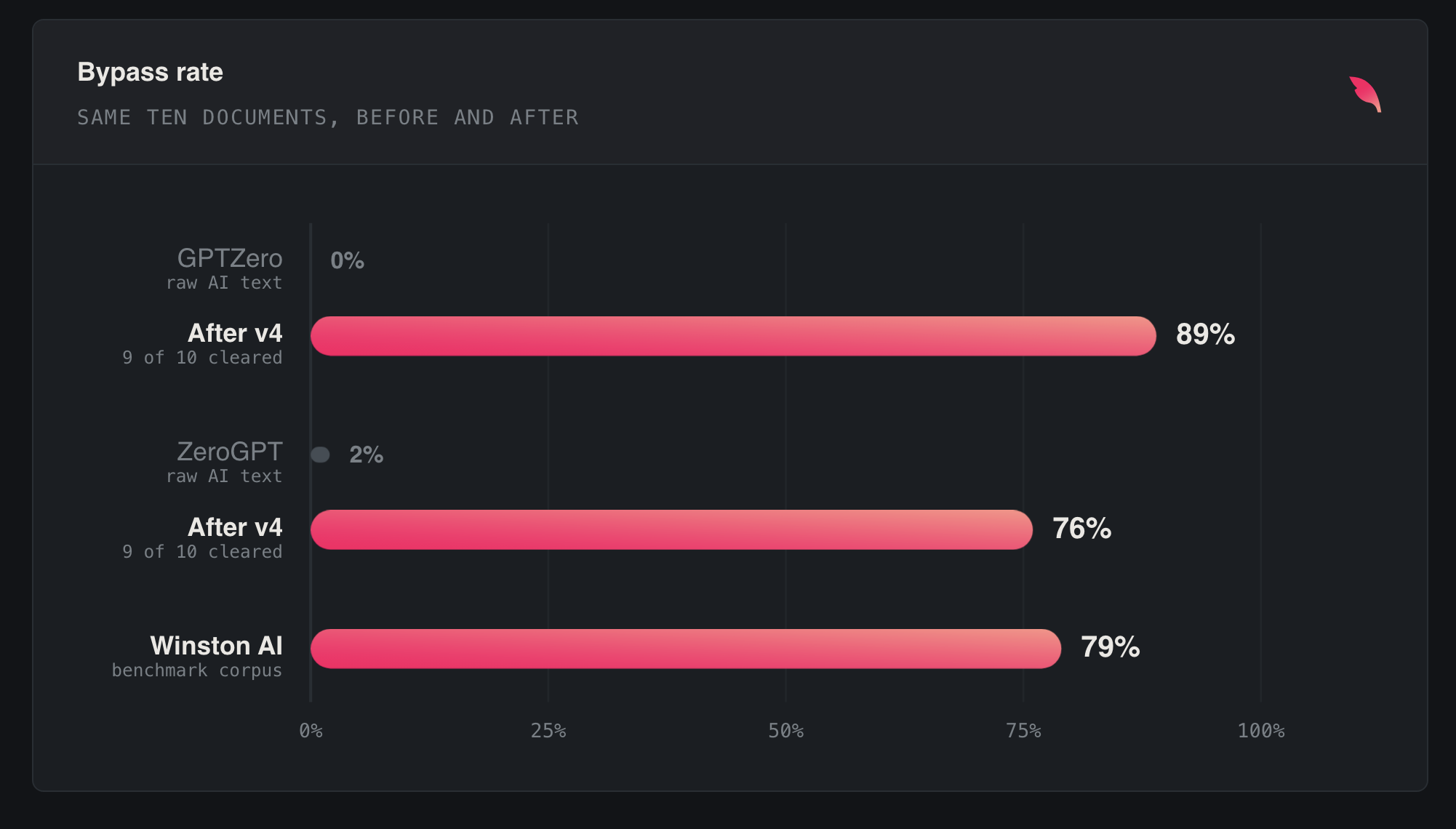
Document by document
Averages hide the shape of a result, so here is every document in the test. Anything above the line reads as human to GPTZero.
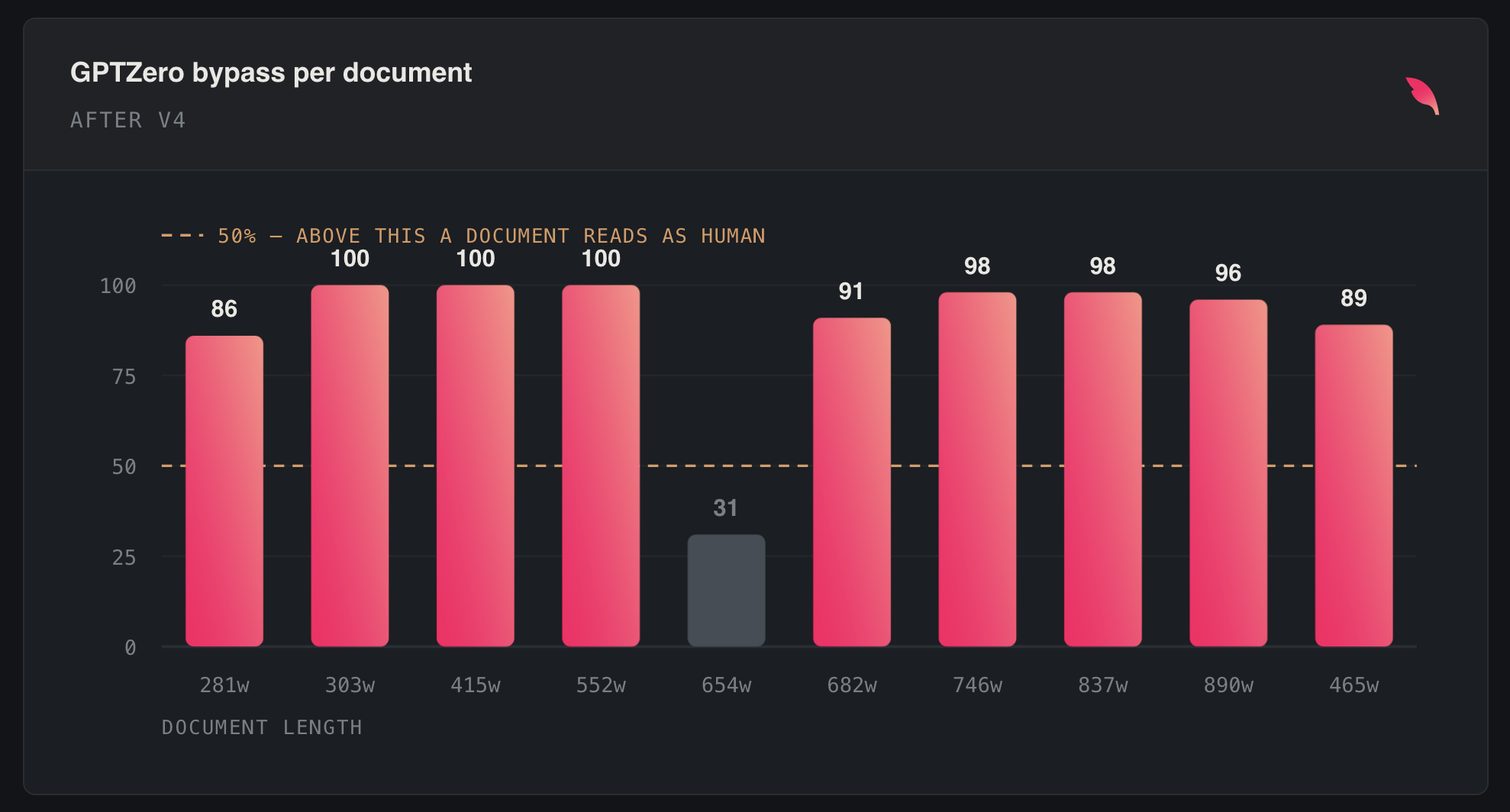
Nine documents clear comfortably, most of them at or near the ceiling. One - the 654-word article in the middle - does not, and we are showing it rather than averaging it away. Hitting rehumanize on that document is what the button is for.
It works across all text lengths
A paragraph for an assignment, a product description, an email - short texts are where most people spend most of their credits, and they are the hardest thing to humanize. A detector has less to go on and a rewrite has less room to move. Most tools fall apart here. v4 is at its strongest.
What survives the rewrite
This is the half that usually goes unpublished. Bypass without fidelity is not a feature: rewrite a text aggressively enough and detectors lose the trail along with your argument, your figures and part of your words.
| v4
| What it measures
|
Meaning kept
| 0.925
| similarity between your text and the output
|
Length kept
| 1.05×
| you get back what you put in, not a shortened version
|
Time per document
| 5.1s
| 600–1,000 words, end to end
|
That middle row matters more than it looks. A humanizer that quietly hands back 90% of your essay has not humanized it - it has cut it, and you would have to notice on your own.
Internal processing:Requests are prepared, rewritten and reviewed in stages before anything is returned. Documents that fail review are regenerated automatically and the best result is returned. We do not publish the specifics of that pipeline.
How it compares to the market
We also put v4 against WriteHuman on a public humanizer benchmark corpus, scored the same way on the same three detectors.
What didn't work
Two findings from this round are worth writing down, because they are the approaches most people try first.
Prompt engineering is finished as a strategy
We built more than ten prompt variants aimed at known detector weaknesses - sentence length variation, banned vocabulary, forced irregularity. None of them moved the numbers beyond noise, and the strictest ones were caught more reliably than a plain prompt. You cannot instruct your way past a classifier that was trained on instructed text.
Grading the writing makes it worse
We tried scoring outputs on how well written they were and regenerating the weak ones. That pushes text back towards clean, polished prose - precisely what detectors are trained to recognise. Slightly uneven writing is not a defect in this domain. Smoothing it out is.
Check the numbers yourself
The full sample set ships with this post as a single CSV: every source document, every output, and every score above. Ten documents, twenty rows. Everything in this article is recomputable from it - we would rather you checked than took our word.
What this means for you
In the app: v4 is in the model list today and is the new default recommendation.
On the API: pass "model": "v4".
v3 keeps its writing styles — creative, journalistic, professional, natural, irregular — and stays the right pick when you want output that sounds like a particular kind of writer.
v2 is retired from the app. It keeps working on the API for existing integrations, with no removal date.