Not a visible label, and not metadata that disappears on copy and paste. The signal sits in the words themselves, and within the next few weeks it becomes standard for eligible ChatGPT and Codex output in the European Union.
The announcement trended on X within hours, and the replies split into two camps. One called it the end of an era for AI writing. The other joked that the fix is to rewrite the text or run it through a different model. Both are partly right, and OpenAI's own numbers show why.
What OpenAI announced: the ChatGPT watermark in the EU
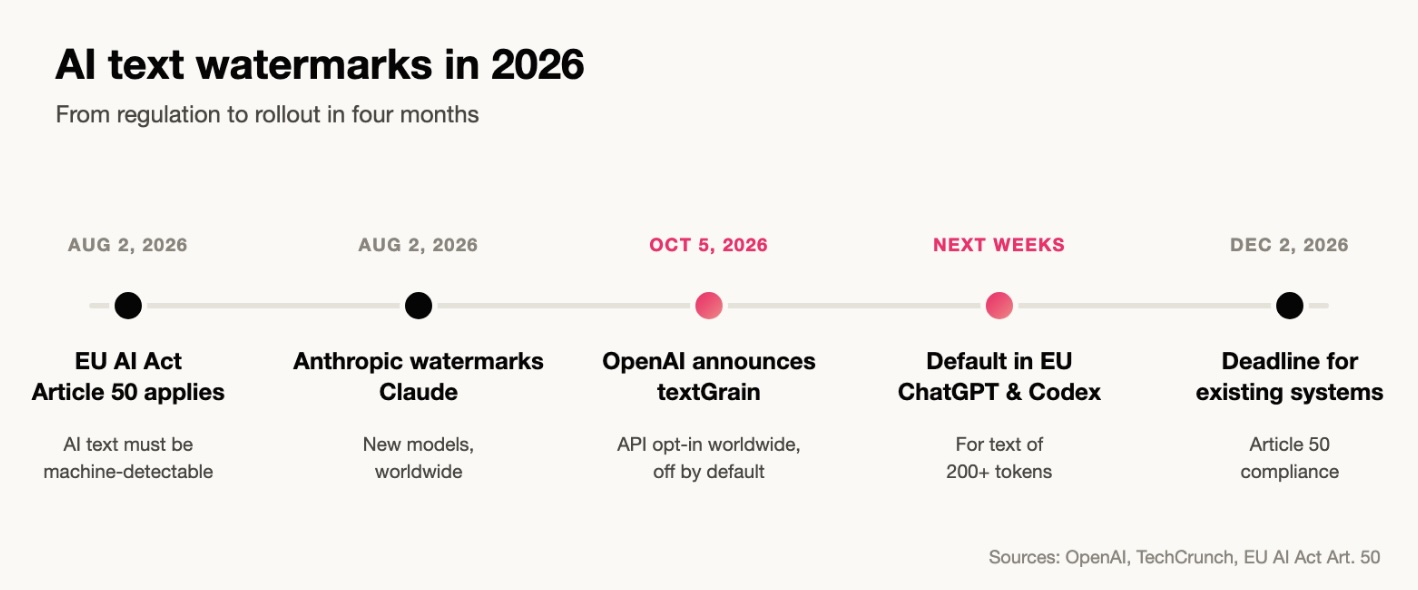
The facts, from OpenAI's post "Our approach to EU text provenance rules" and the technical report published with it:
The reason is regulatory. Article 50 of the EU AI Act has applied since August 2, 2026. It requires AI-generated text to be "marked in a machine-readable format and detectable as artificially generated." Systems that were already on the market have until December 2, 2026 to comply. OpenAI is not the first to do this. Anthropic began watermarking Claude's text on August 2, and it applies the watermark worldwide, not only in the EU.
How does the ChatGPT watermark work?
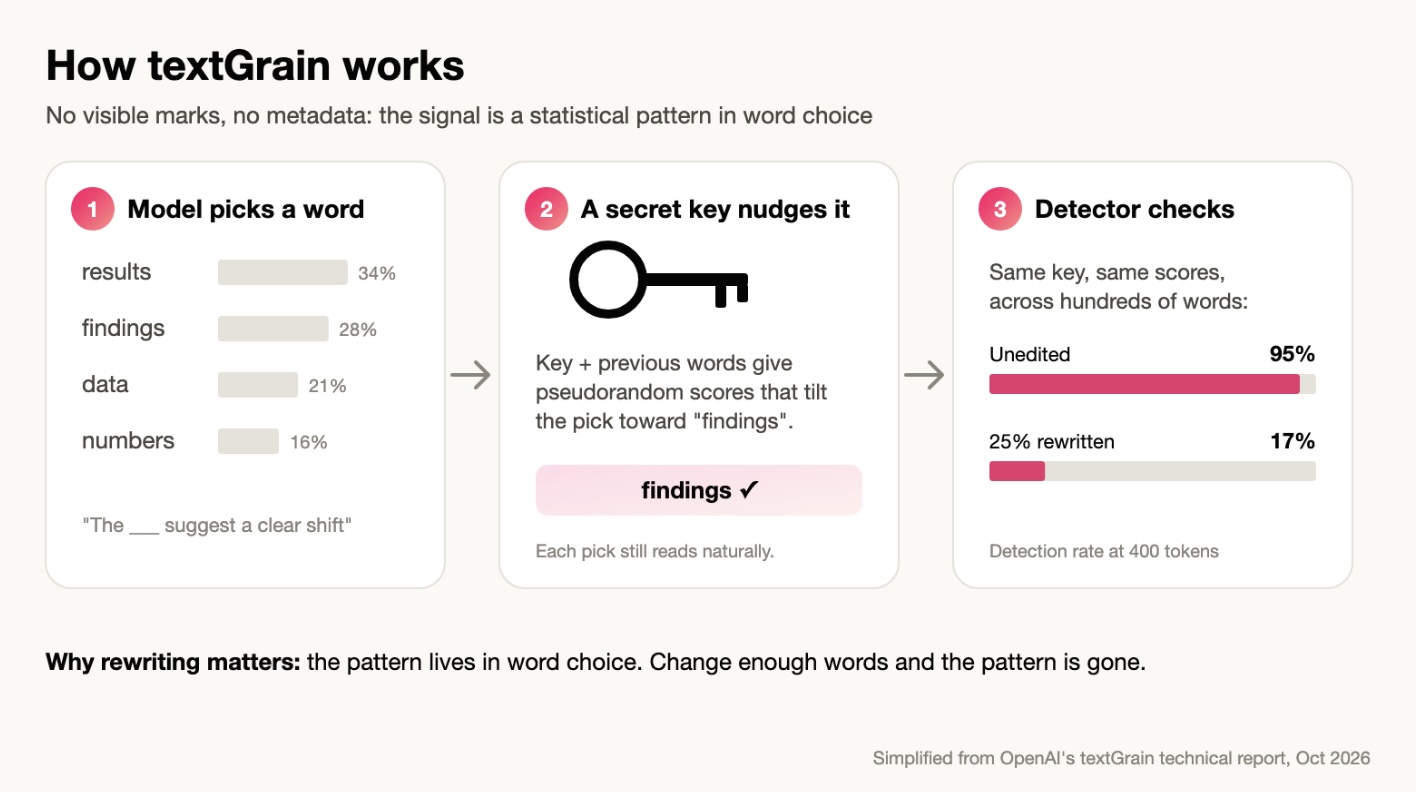
A language model writes one token at a time. At each step it has a list of plausible next words, each with a probability, and it samples one.
textGrain leaves that list alone but changes how the model picks from it. A secret key, combined with the preceding words, produces pseudorandom numbers. The model is nudged toward the candidates those numbers favour. Each single choice still looks natural, and OpenAI says it saw no meaningful change in output quality. But over a few hundred tokens the choices line up with the key in a way that ordinary writing never would.
The detector needs only two things: the text and the key. It recomputes the numbers and measures how strongly the words follow them. No database of conversations is involved, and that is why the watermark survives copy and paste into Word, Google Docs or a CMS.
How accurate is the ChatGPT watermark detector?
OpenAI was unusually open about the limits. All figures below are at a 1% false-positive rate, meaning 1 in 100 human-written texts would be wrongly flagged. That is still a lot if you are the one who gets flagged.
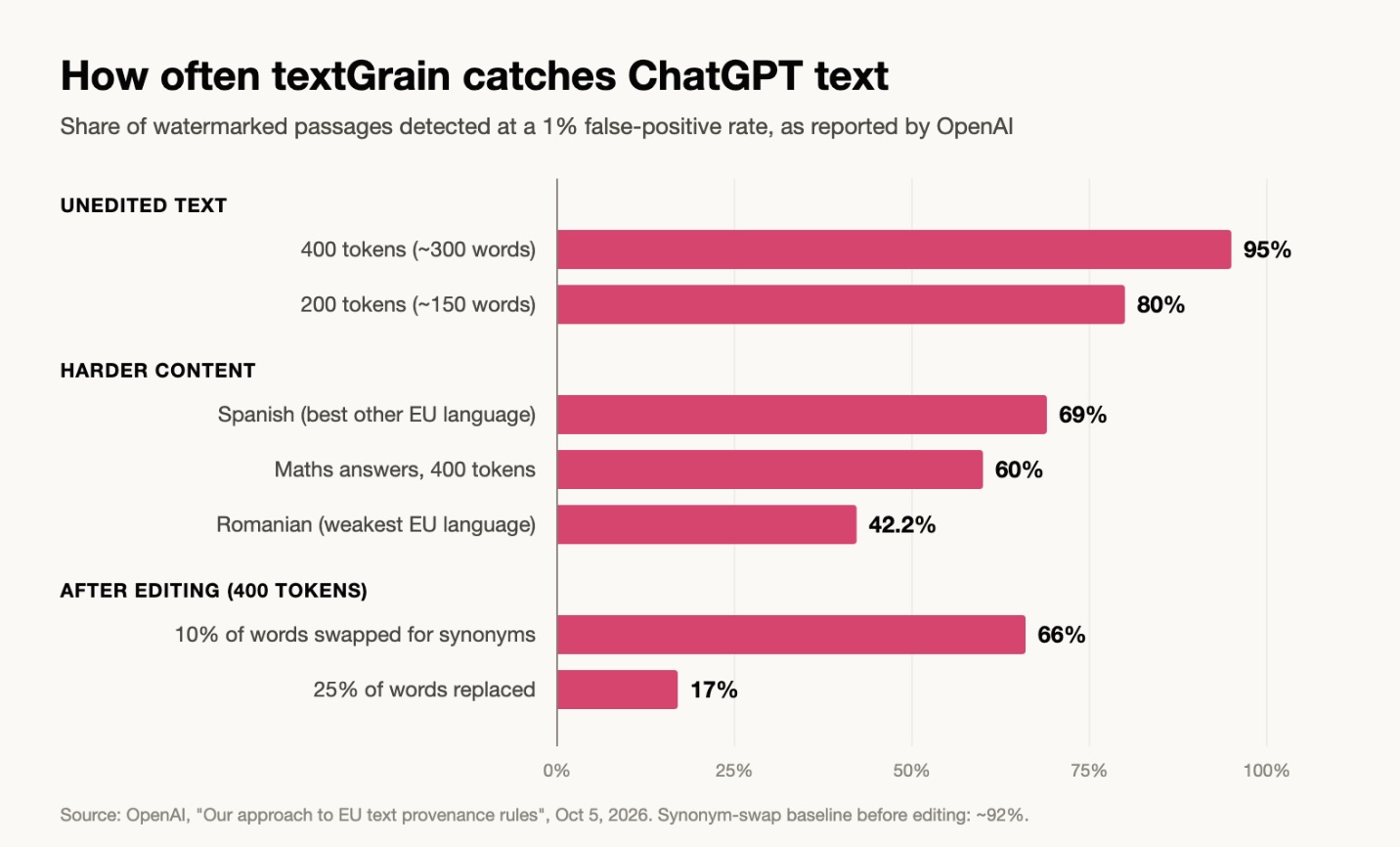
Unedited, 400 tokens (about 300 words): around 95% detected.
Unedited, 200 tokens: around 80%. Length matters a lot.
Maths answers: around 60% at 400 tokens, because there are few "free" word choices to carry the signal.
Other EU languages: between 42.2% (Romanian) and 69.0% (Spanish).
10% of words swapped for synonyms: detection falls from roughly 92% to 66%.
25% of words replaced: 17%.
That last line is the most important one. textGrain is designed to survive light edits and copy and paste, and it does. It is not designed to survive a real rewrite. A watermark that lives in word choice disappears when the word choice changes.
What the ChatGPT watermark means if you write with AI
Pasting raw ChatGPT output is now traceable, at least by some people. Today that group is small. But the Code of Practice behind Article 50 lists educational institutions, media and fact-checkers among the organisations that should get free detector access. Expect universities and publishers in Europe to ask for it.
A missing watermark proves nothing. Text from open-weight models carries no mark. Short text is exempt. Edited text loses the signal. And Claude, Gemini and ChatGPT each use their own scheme and key. OpenAI says it plainly: no watermark does not mean human.
Watermarks and AI detectors are two different things. GPTZero, Turnitin, Pangram and Originality do not read watermarks. They classify style: predictable phrasing, uniform sentence length, the "delve" vocabulary. A text can pass a watermark check and still be flagged by a classifier, and the reverse is also true. Anyone who publishes AI-assisted writing now has two filters to think about, not one.
Can you remove the ChatGPT watermark?
This is the second camp from the X replies, the people saying "just rewrite it." They are right about the mechanism. A light synonym spinner is not enough: it touches 5 to 10% of the words, and OpenAI's numbers show the signal is still there at that level. A proper rewrite changes sentence structure, order and vocabulary across the whole text. That moves word choice far beyond the 25% point where detection collapsed, and it changes the stylistic fingerprint that classifier detectors look for.
That is what dedicated AI humanizers do. Rephrasy, for example, rewrites the full text rather than swapping words and lets you check the result against an AI detector in the same step, which is useful because classifier detectors are the ones readers and teachers can actually run today.
One honest caveat. No humanizer can currently prove that it removes textGrain, because the detector is not public. Any tool claiming to be "textGrain-proof" this week is guessing. What can be said from OpenAI's own data is narrower and more useful: the more of the text that is genuinely rewritten, the less of the watermark remains.
Using AI text responsibly under the EU AI Act
A watermark is a transparency tool, and rewriting text does not remove your obligations. If your university or employer requires you to disclose AI use, that rule applies regardless of what a detector can see. Under Article 50, AI-generated text published to inform the public on matters of public interest must be labelled, unless a human has reviewed it and taken editorial responsibility.
The good uses of a humanizer were always the same ones. Turning a stiff first draft into something that sounds like you. Helping non-native speakers write naturally. Fixing human writing that a classifier wrongly flags as AI. textGrain does not change that. It just makes the difference between pasting and actually editing visible.
FAQ: ChatGPT watermark
Does ChatGPT have a watermark?
Yes, for users in the EU. From October 2026, OpenAI adds its invisible textGrain watermark to eligible ChatGPT and Codex text. Outside the EU it is off for now, but API developers can switch it on.
Can you see the ChatGPT watermark?
No. There are no hidden characters or metadata. The watermark is a statistical pattern in word choice that only a detector with OpenAI's secret key can measure.
Can teachers or Turnitin detect the ChatGPT watermark?
Not yet. The textGrain detector is limited to approved researchers and organisations, and Turnitin, GPTZero and similar AI detectors do not read watermarks. They classify writing style instead.
Does copy and paste remove the ChatGPT watermark?
No. The signal is in the words, so it survives copying into Word, Google Docs or a CMS.
How do you remove the ChatGPT watermark?
OpenAI's own data shows that detection drops to 17% once a quarter of the words change. A full rewrite, by hand or with an AI humanizer, removes most of the signal. Light synonym swapping does not.
Is Claude text watermarked too?
Yes. Anthropic has watermarked text from new Claude models worldwide since August 2, 2026, using a method derived from Google's SynthID-Text.
The bottom line
It works well on long, unedited text (about 95% at 300 words) and gets much weaker with editing (17% once a quarter of the words change), on short text, on maths and in many EU languages.
If you write with AI, the safe habit is the same as before: edit properly, rewrite rather than paste, and disclose where the rules require it.
Sources: OpenAI, "Our approach to EU text provenance rules" (Oct 5, 2026); textGrain technical report;