The Ghost in the Machine: Can AI Humanizers Actually Fool Turnitin in 2025?
The cat-and-mouse game of the decade isn’t between hackers and firewalls—it’s between students trying to "humanize" their essays and the algorithms built to catch them.
On one side, we have Turnitin, the academic integrity giant that claims to sniff out machine-generated text with over 98% accuracy. On the other, a booming industry of "AI Humanizers" (like StealthWriter, QuillBot, and newer entrants) that promise to scrub the "robotic" scent off your ChatGPT drafts.
In late 2025, the battle lines have shifted. The simple tricks of 2023 no longer work, and Turnitin has rolled out aggressive updates specifically targeting these "bypasser" tools. So, who is winning?
The Short Answer: It’s Complicated but possible
Can AI humanizers fool AI Detectors like Turnitin? Yes, but with diminishing returns.
While early humanizers could easily bypass detectors by swapping a few synonyms, Turnitin’s "August 2025" update introduced a specialized "AI Paraphrasing" detection feature. This means the system no longer just looks for "Is this AI?" It now asks, "Was this AI that someone tried to hide?"
Recent independent tests suggest that while raw AI text is detected nearly 100% of the time, "humanized" text still slips through the cracks—but at a much lower rate than before. The detection rate for high-quality humanized text currently hovers between 20% and 95%, meaning it’s a gamble, not a guarantee.
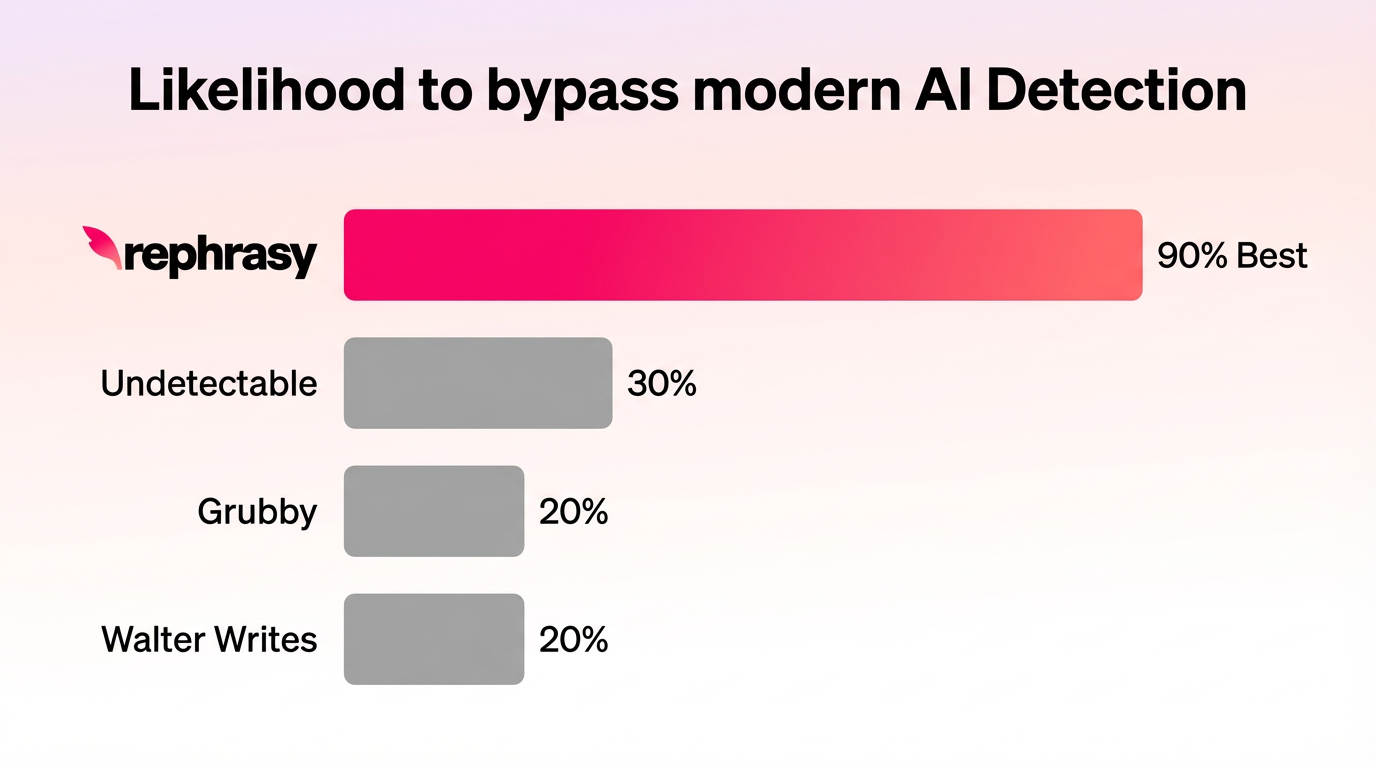
Chart is based on an internal test on different modern AI Detectors.
Under the Hood: Perplexity vs. Patterns
To understand why this is happening, you have to understand the two metrics that rule this war: Perplexity and Burstiness.
Burstiness (The Rhythm of Thought): Humans write in bursts. We follow a long, complex sentence with a short, punchy one. AI tends to be monotonous, producing sentences of average length and consistent structure.
Humanizer Goal: Vary sentence length artificially.
Turnitin’s Counter: It analyzes the syntax tree of the sentence. Even if the length varies, the underlying grammatical structure often remains rigid, leaving a "fingerprint" that deep-learning models can spot.
The "False Positive" Crisis
The biggest casualty in this war isn't the cheater—it's the authentic writer.
As Turnitin tightens its dragnet to catch humanized text, the rate of false positives has crept up. Writers with a naturally formal, structured, or concise style (often including non-native English speakers) are increasingly finding their original work flagged as "AI Paraphrased."
This has led to a strange paradox: Students are now dumbing down their vocabulary and intentionally making grammatical errors just to prove they are human.
The Verdict for 2025
If you are relying on a free "humanizer" tool found on the first page of Google, you are likely walking into a trap. AI Detector's have likely already trained its model on that specific tool's output.
The reality is that true humanization requires a human. The only "unpatchable" method to bypass detection remains the old-fashioned one: using AI to brainstorm or outline, but doing the actual sentence-by-sentence writing yourself.
As we move into 2026, we can expect modern AI Detectors to move beyond just analyzing text patterns and start integrating version history tracking—looking not just at what was written, but how it was typed over time. The era of the "magic button" bypass is likely coming to an end.